Tech Notes
VitalTrack vs. Other Brand Devices: Heart Rate Comparison (1)
Comparing the data through the correlation coefficient (R), MAE, and error rate
In cardiovascular research, the accuracy of heart rate (HR) data matters a great deal. In this post we compare heart rate data from VitalTrack and a device from another brand at rest, with no movement. Three metrics were used for the comparison: the correlation coefficient (R), MAE (mean absolute error), and error rate.
Difference in measurement method: ECG vs PPG
Other brand's device (ECG): ECG (electrocardiography) monitors the activity of the heart through electrical signals. Electrodes attached to the skin detect the heart's electrical changes, and this is known to be a highly accurate method of measuring heart rate.
VitalTrack (PPG): PPG (photoplethysmography) uses an optical sensor to detect changes in blood flow. It is generally worn on the wrist or finger and measures heart rate from the optical changes that occur as blood moves with each pulse. PPG is a non-invasive and convenient measurement method that is easy to use in everyday life.
How the data was collected
The experimental procedure was as follows:
The subject rested for three minutes in a stable state without moving.
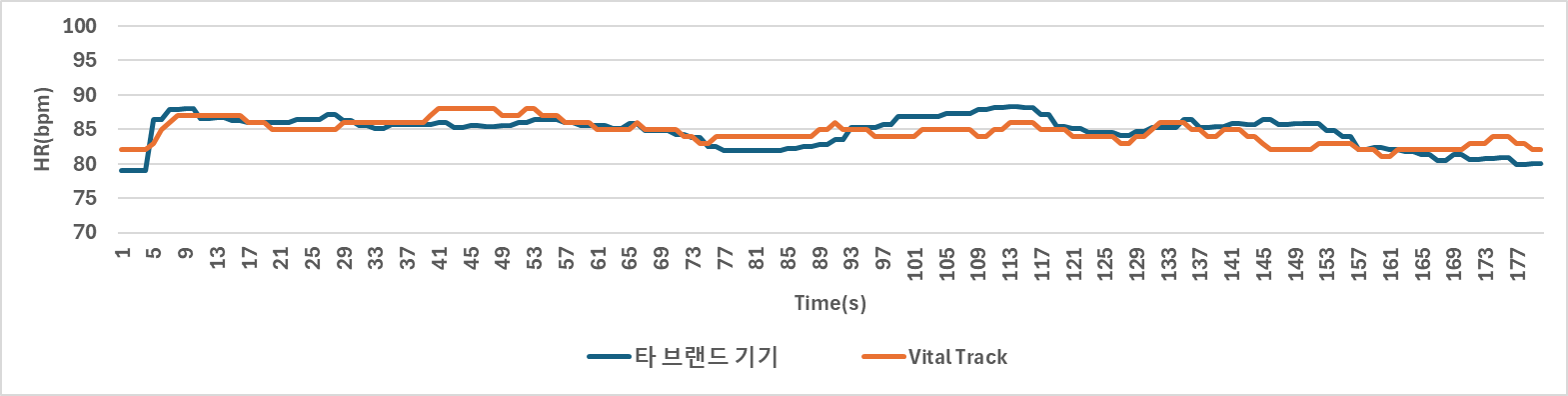
Heart rate was measured with both devices worn at the same time. The other brand's device was worn on the chest to detect the heart's electrical changes, while VitalTrack was worn on the wrist to measure changes in blood flow.
The measured data was recorded at one-second intervals.
Based on the recorded data, R-squared, MAE (mean absolute error), and error rate were calculated to compare the performance of the two devices.
Results

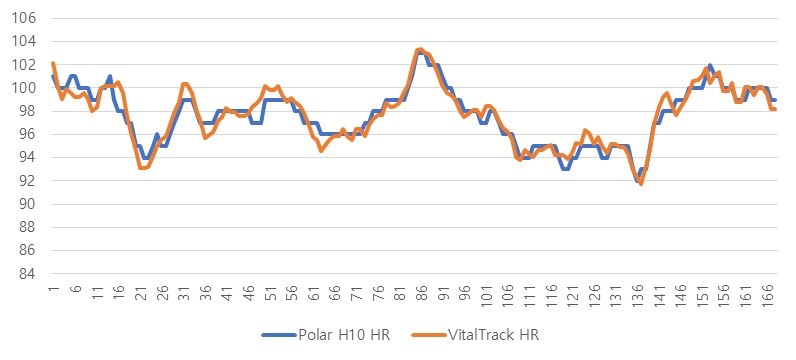
Three-minute HR data comparison: the heart rate data from the two devices showed a similar pattern over time.

Correlation coefficient (R) comparison: a high R value means strong agreement between the data from VitalTrack and the other brand's device.
Correlation coefficient (R)
The R value indicates how well a model explains the data in a regression analysis, and takes a value between -1 and 1. The closer R is to 1, the better the model explains the relationship between the variables. Comparing the heart rate (HR) data from the two devices, the correlation coefficient R came out at 0.9452. This means the data from the two devices shows very high correlation, and a high R value suggests that VitalTrack measures heart rate in a pattern similar to the other brand's device.
MAE (Mean Absolute Error)
MAE indicates the mean absolute error between predicted and actual values. The lower the value, the higher the accuracy of the model. Comparing the HR data from the two devices, the MAE came out at 0.636428. This shows that HR data is being measured within a very small margin of error. Because MAE is a simple average of the errors, it is intuitive to interpret and useful for assessing general predictive performance.
Error Rate (%)
Error rate expresses the relative error between predicted and actual values as a percentage. The lower the value, the higher the accuracy of the model. Comparing the HR data from the two devices, the error rate came out at 0.652397%. An error rate below 1% means VitalTrack provides very accurate heart rate data. The error rate is a convenient metric for assessing performance at a glance, and is particularly useful when several comparison targets are involved.
Overall assessment
Metric | Value | Interpretation |
R (correlation coefficient) | 0.9452 | High agreement between the data from the two devices |
MAE (mean absolute error) | 0.636428 | Data that closely matches the actual heart rate |
Error Rate (%) | 0.652397 | Accurate heart rate data |
Conclusion
Taken together, the correlation coefficient (R), MAE, and error rate results show that VitalTrack's PPG device provides HR data very similar to the other brand's device. The high R-squared value and the low MAE and error rate demonstrate that VitalTrack is accurate and reliable for heart rate measurement. These results mean VitalTrack can provide data useful for cardiovascular research. PPG (photoplethysmography) technology measures heart rate by detecting changes in an optical signal caused by changes in blood flow. This differs from ECG, but its accuracy and reliability have been amply demonstrated in both research and everyday use. With its comfortable fit, non-invasive nature, and continuous monitoring, VitalTrack can be a good choice for heart rate measurement. In the next post we will compare data during movement — walking or running.
For more information, please get in touch at any time or visit our website.